

Edition 41 – November 2025
Dear Colleague,
In this edition we bring you a special In the Loop focussed on the recent CIGRE Conference in Adelaide, “Shaping the Power System of Tomorrow”. It provides a concise reminder of the material covered for those who attended and a demonstration of the relevance of the material for those who may be interested in going to the next one in 2027.
Some important events to round out the year are:
- The Australian Technical Committee Presentation Day in Melbourne on November 20 which provides overviews of the work of the 16 Australian Panels/Study Committees. Details available here.
- The 2025 Annual End of Year Dinner in Melbourne on the evening of November 20 which will be an excellent networking opportunity. The dinner is subsidised for individual members and employees of Collective members. Details available here.
- The Annual General Meeting of CIGRE Australia open to members and member organisations, scheduled for Friday November 21 at 11am AEDT, in person in Melbourne and by webinar. Details available here.
Looking forward, the 2026 biennial Paris Session will be held August 23 – 28, 2026. This is the leading global event for the industry with more than 4,500 delegates, 11,200 power industry participants and 1,100 papers with 99 countries represented in 2024. Following the record attendance in 2024, it is possible that the Session may sell out, so make sure you get in early. Details available here.
Best regards,
Peter McIntyre
Chief Executive Officer
CIGRE Australia
Phil Southwell
Technical Editor
‘Shaping the Power Systems of Tomorrow’
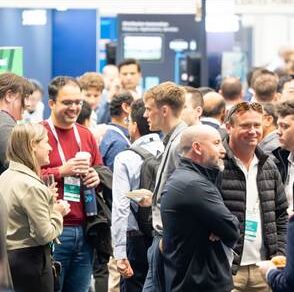
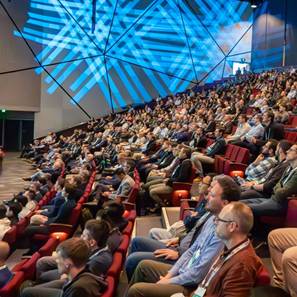
This is a special edition of In the Loop which provides an insight into topics covered at the Adelaide CIGRE conference, ‘Shaping the Power Systems of Tomorrow’ in September this year which had over 1000 attendees and has been very well received. The conference proved to be an ideal platform for knowledge exchange, lively discussions and excellent networking opportunities.
It consisted of three key note presentations followed by presentations in four parallel streams:
- A General Conference (3 days) – focussed on the challenges and innovations of the energy transition (notes prepared by Alex Cruickshank);
- A CIDER Conference (2 days) (Conference on the Integration of Distributed Energy Resources) – facilitating practical conversations and information sharing between utilities product suppliers and communities (notes prepared by Jenny Gannon);
- A SEAPAC Conference (2 days) (South East Asia Protection, Automation and Control Conference) – Attracting the full spectrum of specialists in the areas of protection, telecommunications, SCADA and asset management (notes prepared by Rob Coggan).
- NEXTGEN Power Professionals Seminar (1day) (Notes prepared by Adrian Lloyd).
The following gives a high-level review of the technical topics covered, including summaries of a small selection of presentations.
Key note presentations
CIGRE President, Konstantin Papailou
It was noted that CIGRE produces a wide range of publications. The key focus at this time is on the energy transition. A global perspective was provided on the challenge of meeting global demand with clean energy by 2050. According to the IEA World Energy Outlook:
- The global electric power demand for the zero emissions scenario in 2050 is expected to be between about 25000 – 40000 GW.
- The installed capacity of all energy sources today is about 10700 GW, out of which 3300 GW are RES and 400 GW nuclear.
- This means that an additional 20000 – 35000 GW are required, i.e. more than 1000 x 1000 MW power plants per year would have to be set up and running by 2050!
- The majority will be wind and solar with some nuclear, as realistically widespread commercial fusion power might not arrive until mid-century due to engineering challenges and regulatory approvals.
- The total requirement for new HV overhead lines by 2050 is expected to be about 4.5 – 8.5 million km!
As a non-governmental, non-profit organisation, CIGRE’s mission is to:
- Raise our voice and point out the problems to technical and non-technical audiences, in particular politicians and the media.
- Attract and educate young people (NGN).
- Utilise better our human capital (LGN).
- Support research initiatives and humanitarian projects related to the energy transition.
CIGRE is investing in innovation and expertise for the global future of power systems and is introducing the CIGRE Innovation and Education fund, a worldwide programme providing grants for research, scholarships and educational initiatives for the energy transition and more.
AEMO, Nicola Falcon
A snapshot was provided of the Australian challenge and how plans are being developed to achieve zero emissions from the electrical sector by 2050. Small power systems such as those in WA and SA are current examples of the extent of variability of demand when using solar and wind as a large proportion of generation. The plans will also address how we can manage these power systems when the solar and wind generation is greater than the electrical demand.
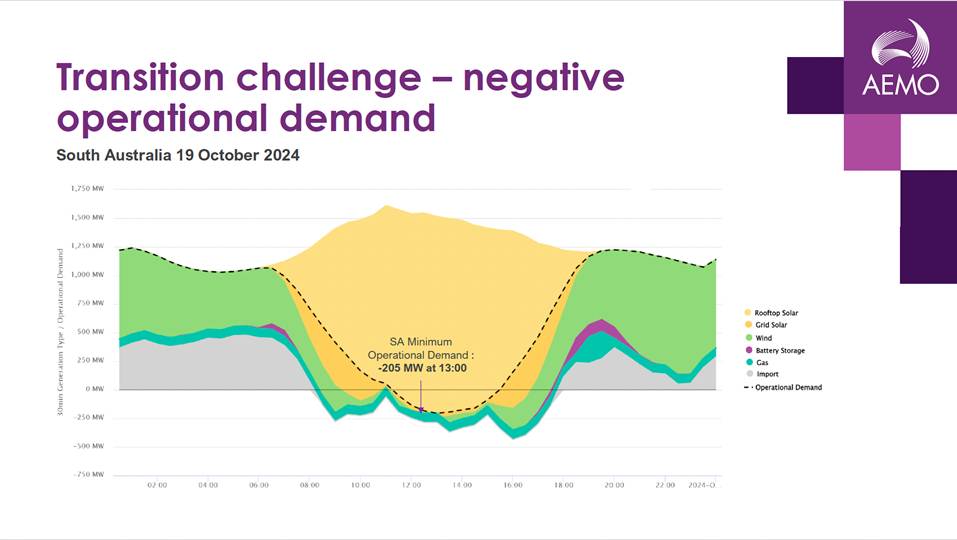
AEMO have produced their annual General Power System Risk Review of current and emerging risks. The main risks are identified as:
- Inverter based resource response to remote frequency events
- Minimum system load
- Unexpected operation and interaction of protection systems and control schemes
- Increasing risk of non-credible contingencies
Further information on the work of AEMO is available from their website: aemo.com.au.
National Electricity Market (NEM) Review
Draft report and recommendations presented by Tim Nelson (Chair of the review).
In broad terms, the review outlines recommendations for reforms in the NEM to enhance market efficiency, transparency and investment in electricity services. It considers short term spot markets, medium term derivatives markets and long-term investment markets as well as the linkages with network tariffs and retail pricing.
Core recommendations from the review are:
- Retain the current energy-only market. Energy ministers should require a broader range of price-responsive resources to be visible or dispatchable, allowing them to be part of price formation.
- Establish a process to allow industry (buyers and sellers) to define core derivative contracts for bulk energy, shaping and firming – these core products will be the subject of a market making obligation.
- Energy ministers should establish an Electricity Services Entry Mechanism within the NEL to facilitate investment in the NEM.
- AEMC Reliability Panel to take a long-term view of the market price settings.
In general, the panel focused on reforms that: align with the federated structure; complement the existing wholesale market; target economic efficiency and deliver benefits for electricity users. The report concludes with a roadmap for implementation, targeting reforms to stabilise prices, unlock investment and improve outcomes for all stakeholders in the NEM.
The draft report was issued in August and the final report is expected to be issued towards the end of 2025.
General Conference
The following presentation summaries have been selected from all the presentations made over the three days.
Presentation 1123 by Alan Luc (Ausgrid) and Ikumi Nakanishi (Ausgrid) on Project Edith
This presentation discussed Project Edith which is a good example of the changes to the pricing of networks needed to support the transition to renewables, particularly the large increase in Consumer Energy Resources.
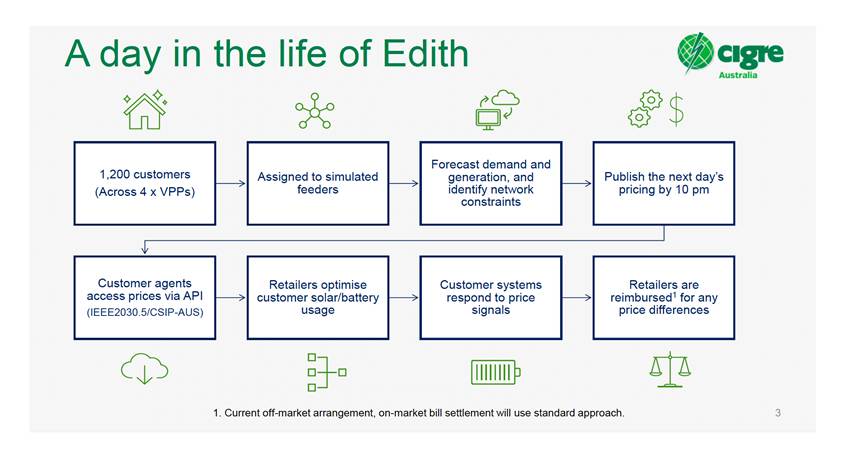
Project Edith is being run by Ausgrid which, as a distribution system operator, is demonstrating a decentralised and cost-effective way of managing network capacity in a growing two-sided market. Project Edith demonstrates dynamic network pricing by utilising real-time network data and near-term forecasting. This approach enables very low-cost network access most of the time, with higher prices applied only as network capacity approaches its limits, whether due to load or exports.
At times, prices can be negative, rewarding customers for exports or imports that offset the peaks caused by other customers’ use of the network. The presentation showcased the progress of the pricing engine’s development, including the integration of network constraints as a pricing driver and the response of customer devices. It also discussed the anticipated impact of dynamic pricing on market participation and the path toward maturity.
AEMO forecasts that about 85% of consumer energy resource capacity will need to be coordinated by 2050. Project Edith is being used to test ways in which dynamic network pricing can be used to:
▪ Remove barriers to consumers participating in the energy market.
▪ Smooth out the consumers’ load and export.
▪ Manage network constraints with a pricing-first approach
The attached picture illustrates the process involved.
Presentation 1287 by Babak Badrzadeh (Bespoke Energy) on “Modelling Considerations for Large Inverter-Based Loads Focusing on Data Centres and Electrolysers”
The presentation began with a summary of the relevance and timelines for large load modelling performance challenges, including modelling of high draw facilities with integral UPS connected to the grid. The work is directly relevant to issues in the network and the broader power system, as the need for high-capacity connections increases.
This was followed by a summary of the key components used in data centres and electrolysers and the most relevant performance aspects. This included modelling considerations for representing data centre demand in dynamic studies, especially where vendor-specific models are unavailable. It then provided a table of a suitable modelling approach for data centres. It also discussed a number of characteristics that make standard modelling tools less effective than is needed for these studies and provided commentary on building fit for purpose models.
CIDER 2025: Showcasing Innovation in Distributed Energy Resources
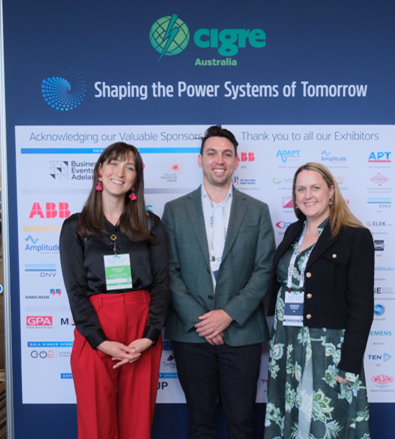
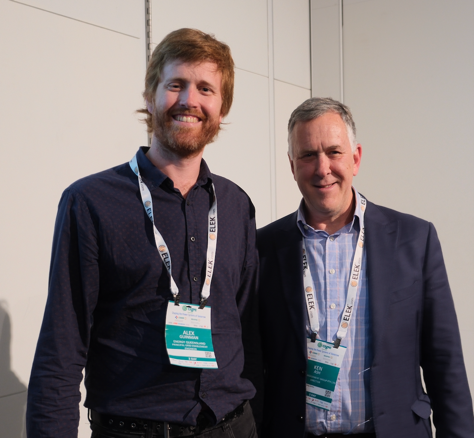
At the 6th Conference for Integration of Distributed Energy Resources (CIDER), Alex Guinman, Principal Grid Enablement Engineer at Energy Queensland, received the award for Best Presentation for his talk on “Learnings from Queensland’s Distribution Energy Resources Management System (DERMS) Deployment for Dynamic Operating Envelopes (DOE).”
Queensland is leading the way with one of the world’s first production DERMS systems, currently in testing and scheduled for release by the end of 2025. This system is designed to communicate DOEs to customers, unlocking additional hosting capacity and scaling to thousands of new connections each month. By enabling DOE connections, the approach optimises both DER profitability and grid utilisation—a true win-win for customers and networks.
Alex provided insights into the system architecture, key design decisions, integration challenges, and lessons learned during deployment. For those embarking on similar journeys, he shared a roadmap for future improvements and a valuable reminder: “Don’t let perfect be the enemy of good—focus on delivering a minimum viable product at each stage.”
The keynote address by Michelle Howie, Technology Innovation Manager at South Australia Power Networks, explored the future of electric vehicles and vehicle-to-grid integration in Australia. Michelle highlighted the critical steps already taken and the ongoing work required to ensure success. Her closing message resonated with the CIGRE spirit to learn from each other locally, and don’t forget to look overseas to share and learn.
The Next Generation Network (NGN) brought energy and engagement with two standout sessions. The interactive challenge, “Wrangling the Duck in a NextGen Grid – Are You Ready?”, tested the audience’s ability to make operational decisions under pressure—though the grid wasn’t quite saved! It was great work keeping the participants humble. A thought-provoking NGN panel followed, discussing historical lessons for a high-DER future, featuring experts from AEMO, AGL, EQL, TransGrid, and QUT.
CIDER 2025 showcased the depth of technical expertise overall but importantly of our emerging DER leaders within our NGN. With collaboration and innovation at the forefront, the future looks bright as Australia tackles the challenges of integrating solar, batteries, and electric vehicles into its energy networks.
SEAPAC25: Shaping the Future of Protection, Automation & Control
What happens when the brightest minds in protection, automation, and control come together? Innovation, collaboration and a glimpse into the future of our power systems.
The 9th South East Asia Protection, Automation and Control Conference (SEAPAC) did just that – bringing together experts from Australia, New Zealand, and across the world for two days of deep technical exchange. From asset owners and consultants to vendors and educators, the event was a melting pot of ideas tackling some of the most pressing challenges in our industry.
SEAPAC explored transmission system protection, virtualisation and interoperability, distribution feeder protection and monitoring, large network protections, fleets and big data, measurements for protection, monitoring and metering, testing commissioning and operation and challenging protection applications.
The presenters and audience spotlighted a continued shift towards smarter, more resilient grids. Key themes included dynamic system rating and PMU-guided black start restoration, advanced protection strategies for power swings, earth faults, and subsynchronous resonance, and the accelerating influence of digitalisation in protection systems. Presenters showcased how virtualised relays, analytics, and advanced fault detection are transforming grid resilience and security from concept to reality.
Insights were had into scalable protection device management, inspired by telecom practices, and the power of data-driven diagnostics for circuit breaker operations. The importance of secure engineering access, underpinned by Zero Trust principles, was highlighted. Technical challenges in deploying sampled value busbar schemes and the use of Low Power Instrument transformers were unpacked, with a sharp focus on protection system behaviour.
The topics explored at SEAPAC underscore a collective industry push towards digitalisation, cybersecurity, protection system performance, and operational reliability that continue to set the stage for a more intelligent and robust energy future.
As part of the Session, we discussed Virtualised Protection (VPAC). Imagine replacing traditional hardware relays with software-based protection functions running on virtual machines. Leveraging IEC 61850, high-speed fibre, and even 5G, VPAC promises flexibility, scalability, and vendor agnostic solutions for protection within digital substations and line protections beyond.
As the power system evolves in Australia it is becoming more complex, a challenge seen around the world. The challenges of protection and automation are evolving fast as are the opportunities to solve them. SEAPAC25 showed that with collaboration and innovation, we’re ready to meet these challenges head-on.
NEXTGEN Power Professionals Seminar
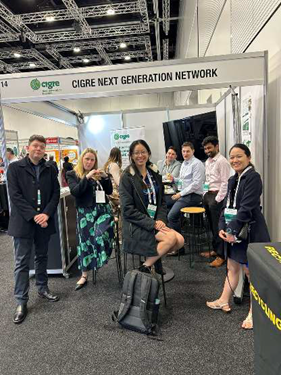
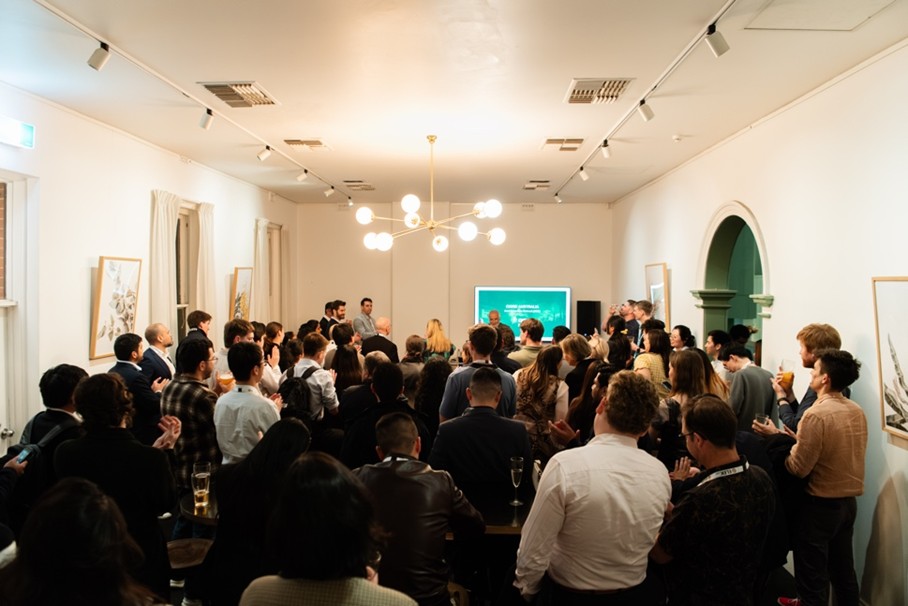
The inaugural NextGen Power Professionals Seminar, hosted by CIGRE Australia’s Next Generation Network (NGN), brought together emerging industry professionals, students, and industry leaders to explore the future of power systems as part of the CIGRE Australia conference in Adelaide. The seminar focused on professional development, technical innovation, and collaboration. With the theme “Bridging Talent and Technology for a Smarter Grid,” sessions explored new digital tools, emerging technologies and provided a platform for NGN members to share knowledge and insights about their work and experiences. This was an event for the next generation, hosted by the next generation.
Professional and Personal Development for the NEXTGEN
Kicking off with the topic of AI in Power – Microsoft’s Felicity McNish and Jon Eime led a hands-on workshop showcasing Microsoft Copilot and AI tools for productivity, reporting, and data analysis. The session underscored the growing importance of AI literacy for future engineers. Joseph Leung (DigSILENT Pacific) then discussed the generator connection processes in the National Electricity Market (NEM), highlighting regulatory challenges and the Connections Reform Initiative (CRI). Using a live demo, Joseph presented a practical case study to emphasise the importance of system modelling and compliance in enabling Australia’s energy transition.
Engagement and Insights from the Power Industry
The day’s second sessions started with Rainer Korte – AEMC Commissioner providing a comprehensive overview of Australia’s energy regulatory ecosystem, detailing the roles of AEMC, AEMO, AER, and the Energy and Climate Ministerial Council. He outlined eight strategic challenges for achieving a net-zero energy system and emphasised the role of engineers in bridging policy and practice.
The seminar then introduced a new presentation format, dubbed the ‘NEXTGEN Open Mic Session’. Taking inspiration from the General Discussion Meetings at Paris, this session saw several NGN members present responses to a problem statement on the industry challenges and opportunities posed by emerging technologies. Through short (3min) yet insightful presentations, the speakers explored a variety of topics including V2G, AI-based inverter modelling, social license, and grid health reporting, among others.
NEXTGEN Technical Presentations
The final session for the day consisted of technical presentations from our NGN members. These presentations, on topics such as AI-driven BESS Scheduling, Bushfire Risk Modelling and IEC61850 Process Bus Design, showcased the technical excellence of the NGN cohort and reflected the practical problem-solving efforts that are underway to meet the industry needs. The future of the Australian power industry is clearly in safe hands.
The NEXTGEN Seminar concluded with a sold-out networking event at the local venue, featuring an impromptu keynote by CIGRE President Konstantin Papailiou. The evening fostered meaningful networking and discussions amongst emerging professionals and with industry leaders and proved to be an excellent way to celebrate what was a fantastic day for CIGRE NGN. A more detailed summary of the event is provided in the October 2025 edition of CIGRE’s ELECTRA.
Article Contributors
- CIDER 2025: Showcasing Innovation in Distributed Energy Resources, prepared by Jenny Gannon
- SEAPAC25: Shaping the Future of Protection, Automation & Control, prepared by Rob Coggan
- NEXTGEN Power Professionals Seminar, prepared by Adrian Lloyd